
H.L. Mencken, Part 1: The Helpmate
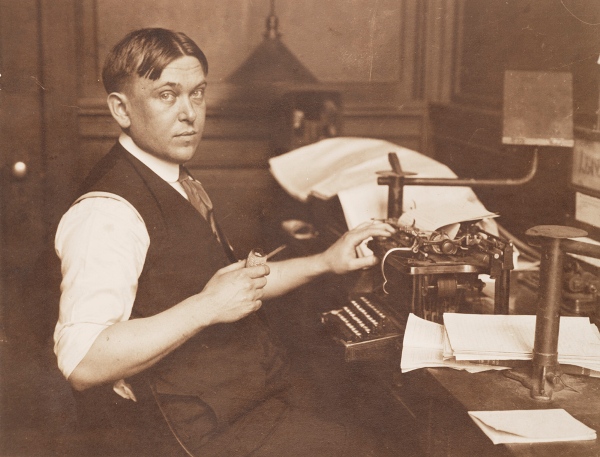
Last year, on one glorious satanic SoCal Sabbath, myself, mamma, and the ducklings explored the resting and almost vacant campus of the University of California in San Diego, what the locals call UCSD (known to the yokels in the nearby desert hills as the den of secularists and liberals). I found the bookstore, entered alone, and sneaked quietly to the textbook section for junior philosophers. It was one of those not so rare moments that I have been surprised by the joy of surrounding myself with the scribblings of free intellects.
Somewhere around Kant and the Churchlands I discovered The Hearts of Men by Barbara Ehrenreich. After a glance at the table of contents (breadwinners, flannel dissidents, playboy, beatnicks, and antifeminist assault on men) I was off with a USED version. The cashier was taken back when I offered cash instead of a student card and I once again suspected that satanic SoCals could see right through my straggly hair and flip-flops, knowing at once that I was really a fundamentalist from North Idaho with ducklings just outside the store doors – a poser and a coward, afraid to meet the Pacific’s shark-free waives with a fiberglass board (my convertible – a plain Toyota – does little for the disguise).
Sinning, I read the book that Sabbath, and the next, and my wife followed upon my request. I liked it. She did not. (I liked 1984 too, and she did not). I have planned to offer some posts on this book, and once I get a chance to review the book again, I will do so. But my reading of late, which has been very little given these economic bread-winning times, has been a scouring of the works of H.L. Mencken. I have decided to share some of Mencken’s works here in the Wood – sooner than later in consideration of Jesus’ immanent return – but I have had a hard time choosing which historic piece of bombast from the good ol’ 1920s and 30s to delight and scare my readers with. This evening I landed on some thoughts about women, and with The Hearts of Men on the back burner, I was finally able to decide on my first selection.
I have discovered Mencken to be a top rate liberator of women and the Negro in his own cussed, comedic way, but given Mencken’s inclination towards science and truth, he never seems to write anything politically, sociologically, and theologically correct. This does unhinge my previous sense of American history, given how tame Christopher Hitchens now appears when compared to the most influential journalist of the first half of the 20th century. These investigations will also inevitably provide further light for my anthropological investigation of Douglas Wilson and his land-locked Ant Hill of ice, gravel, and mud. Wilson was a studious fan of H.L. Mencken just before launching his sociological and journalistic experiment in the early 90s.
Here is Mencken on ‘The Helpmate’, taken from A Mencken Chrestomathy (Vintage Books: Random House, 1982):
Every intelligent woman knows instinctively that the highest aspirations of her husband are fundamentally inimical to her, and that their realization is apt to cost her possession of him. What she dreams of is not an infinitely brilliant husband, but an infinitely “solid” one, which is to say, one bound to her irretrievably by the chains of normalcy. It would delight her to see him get to the White House, for a man in the White House is policed as relentlessly as an archbishop. But it would give her a great deal of disquiet to see him develop into a Goethe or a Wagner.
I have known in my time a good many men of the first talent, as talent is reckoned in America, and most of them have been married. I can’t recall one whose wife appeared to view his achievements with perfect ease of mind. In every case the lady was full of palpable fear – the product of feminine intuition, i.e., of hard realism and common sense – that his rise shook her hold upon him, that he become a worse husband in proportion as he became a better man. In the logic I can discern no flaw. The ideal husband is surely not a man of active and daring mind; he is the man of placid and conforming mind. Here the good business man obviously beats the artist and adventurer. His rewards are all easily translated into domestic comfort and happiness. He is not wobbled by the admiration of the other women, none of whom, however much they may esteem his virtues as a husband, are under any illusion as to his virtues as a lover. Above all, his mind is not analytical, and hence he is not likely to attempt any anatomizing of his marriage – the starting point for the worst sort of domestic infelicity. No man, examining his marriage intelligently, can fail to observe that it is compounded, at least in part, of slavery, and that he is the slave. Happy the woman whose husband is so stupid that he never launches into that coroner’s inquest.
Barbara Ehrenreich no doubt says Amen.

Posted by metzler on Friday, July 17, 2009, at 8:42 pm.
 Print This Post
|
Print This Post
|  Email This Post