
Ayn Rand on Homeschooling

While exploring a bit of American literature last year, I stumbled onto a topic that many folks today would call “homeschooling.” I was surprised by the author who provided the occasion: it was Paul Ryan’s preferred sage, the extravagant Ayn Rand.
I have inferred from Jennifer Burns’ outstanding autobiographical work on Rand (Goddess of the Market, Oxford, 2009) that Rand’s cultish authoritarianism, her drugs, her infidelity, and her own irrational rage—while protesting anti-rationality—have not entirely eclipsed her greatness, and her legacy they never could (you might recall Ted Turner’s 248 billboards asking, “who is John Galt ?”). Perhaps some social conservatives will consider the truth of this suggestion after venturing the following passage from Atlas Shrugged (page 785 in my Plume by Penguin, 1999):
She often saw them wandering down the trails of the valley—two fearless beings, aged seven and four. They seemed to face life as she had faced it. They did not have the look she had seen in the children of the outer world—a look of fear, half-secretive, half-sneering, the look of a child’s defense against an adult, the look of a being in the process of discovering that he is hearing lies and of learning to feel hatred. The two boys had the open, joyous, friendly confidence of kittens who do not expect to get hurt, they had an innocently natural, non-boastful sense of their own value and as innocent a trust in any stranger’s ability to recognize, they had the eager curiosity that would venture anywhere with the certainty that life held nothing unworthy of or closed to discovery, and they looked as if, should they encounter malevolence, they would reject it contemptuously, not as dangerous, but as stupid, they would not accept it in bruised resignation as the law of existence.
“They represent my particular career, Miss Taggart,” said the young mother. . . . “They’re the profession I’ve chosen to practice, which, in spite of all the guff about motherhood, one can’t practice successfully in the outer world. . . . I came here, not merely for the sake of my husband’s profession, but for the sake of my own. I came here in order to bring up my sons as human beings. I would not surrender them to the educational systems devised to stunt a child’s brain, to chaos with which he’s unable to deal, and thus reduce him to a state of chronic terror. You marvel at the difference between my children and those outside, Miss Taggart? Yet the cause is so simple. The cause is that here, in Galt’s Gulch, there’s no person who would not consider it monstrous ever to confront a child with the slightest suggestion of the irrational.”

Posted by metzler on Friday, July 27, 2012, at 5:27 pm.
 Print This Post
|
Print This Post
|  Email This Post
 The kind lady at the local Christian bookstore has been poised with my cell phone number in hand for a few days now, knowing my determination to somehow find an April issue of Christianity Today somewhere in San Diego. “Is there someone you know in this issue?” she asked. “Yes, there is.” Molly Worthen now has a seven page article on my old teacher, titled “The Controversialist.”
 “I
“I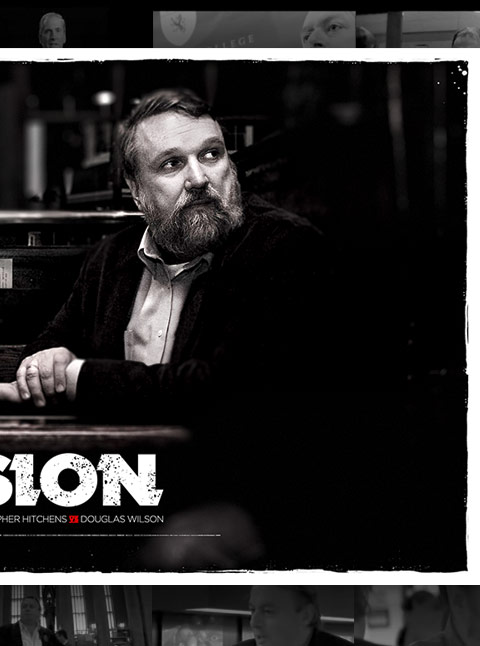 also web published at Christianity Today. As any good professing presuppositionalist would do, Wilson centers the debate on a neo-Van Tillian version of the moral argument. I plan to offer an analysis of this debate and in time get on to seeking some answers for the questions above. For now, I want to challenge Hitchens’ elegant claim that morality is simply “innate.”